
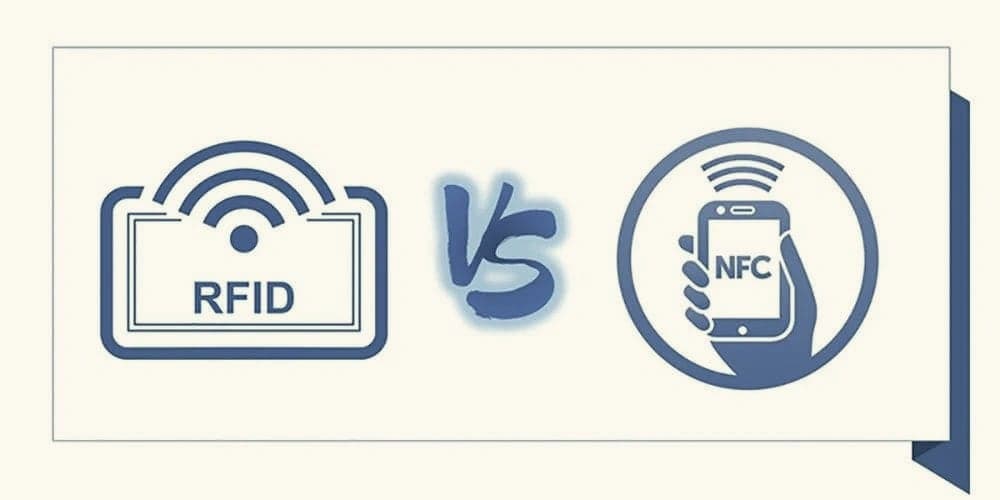
Is NFC the same thing as RFID
NFC belongs to the RFID family. Beyond that shared ancestry it has little in common with the RFID used on a warehouse floor.
Short answer: NFC is a kind of RFID. The longer answer is about what breaks when you try to use one in place of the other.
NFC runs at 13.56 MHz, inside the HF branch of RFID. What sets it apart is two-way communication and the fact that phones support the band.
Short range is a design choice, not a weakness
NFC reads over a few centimetres. That looks like a limitation until you think about payment. You do not want your card read from three metres away by someone walking past. Here the short range is the security feature.
UHF RFID needs the opposite. It has to read the pallet moving through a doorway and the item two metres deep on a shelf. You would not put that tag on a payment card for exactly the reason above.
Where each one belongs
- NFC: product authentication, digital product passports, phone-tappable campaign tags, access cards, contactless payment.
- UHF RFID: inventory counting, shipment verification, asset tracking, shelf management, textile and jewellery stocktaking.
Another way to decide: ask who does the reading. If the customer reads it with their own phone, you need NFC, because no phone has a UHF reader. If your staff read it with a handheld, or a fixed reader does it at the door, you are in UHF territory.
Using both
Some projects carry two tags on one product. Textiles show this well. A UHF tag handles warehouse and store counting, while an NFC tag sewn into the garment serves the customer who wants to verify authenticity or read care instructions with a phone.
It costs more, and it solves two separate problems. That is healthier than expecting one tag to do both jobs badly.
Three questions before you choose
From how far will it be read. Who reads it, staff or consumer. How many tags at once. Those three answers pick the frequency almost by themselves. Everything after that is tag design and mounting detail.